


Fall Semiannual Report
to Congress 2025
April 1 - September 30, 2025

Our Work


We are the U.S. Postal Service Office of Inspector General (USPS OIG) — we’re charged with ensuring the efficiency, accountability, and integrity of the United States Postal Service and its regulator, the Postal Regulatory Commission (PRC). It’s a tall order, seeing we’re one of the smallest oversight agencies compared to our parent agency: for every one OIG employee, there are 691 postal workers.
Our work plays an important role in maintaining the integrity of America’s postal system, its revenue and assets, and its employees. And as recent budgetary constraints have led to a reduced workforce, we continue looking for ways to leverage cutting-edge technology and data analytics to efficiently focus our limited resources.
In the past six months alone, we issued 76 audit reports, management advisories, and white papers, and identified over $1.5 billion in questioned costs. And postal management agreed with 195 (75%) of our recommendations to improve issues we identified.
Our investigations are equally important, with OIG special agents completing 1,348 investigations during this reporting period. Those investigations led to 498 arrests, 476 convictions, and over $186 million in fines, restitution, and recoveries, of which more than $78 million was returned to the Postal Service.
We’re confident an increase in funding would allow us to significantly expand our efforts to protect USPS and the PRC from fraud, waste, and abuse.
This digital story provides a quick recap of the three main areas of our work featured in our 2025 Fall Semiannual Report to Congress.

Postal Crime


Our agency is a leader among the federal oversight community. In addition to expertly trained special agents and support staff, we leverage cutting-edge technology like AI and data analytics to root out postal crime and prevent it from happening.

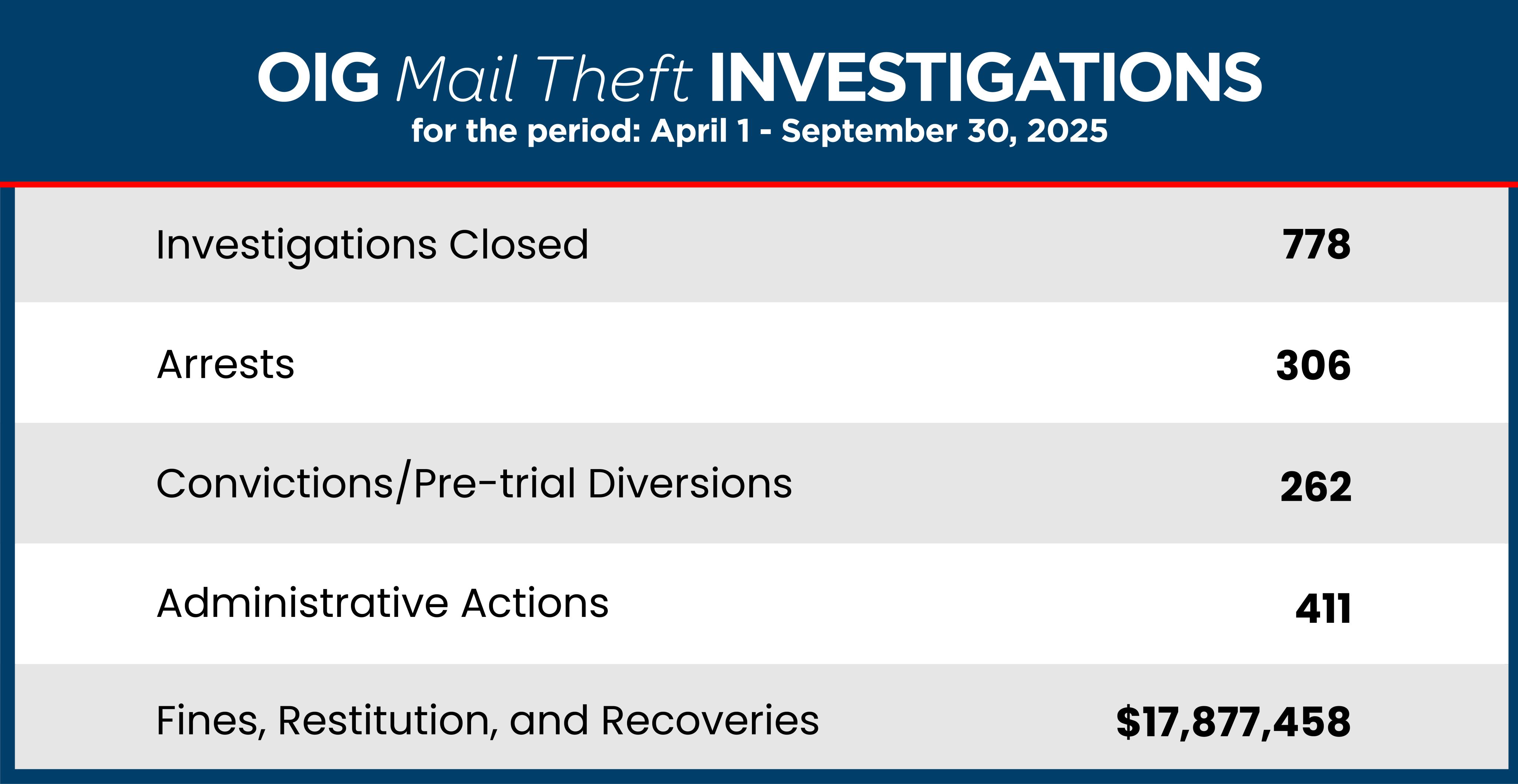


One of the investigations featured in this report details how our special agents worked with law enforcement partners to bring down a mail theft ring that stole more than $17 million from victims in Mobile, AL. Like many criminals seeking to exploit the vast postal network, the group recruited a USPS employee to steal hundreds of checks destined for business PO Boxes at a local post office. The co-conspirator then altered and sold the checks on a social media app with the help of other accomplices.
Investigators arrested the employee and her accomplice, who was found with $10,000 in cash, drugs, a handgun, and stolen checks valued at more than $417,000. The employee was sentenced to five years in prison and ordered to pay over $230,000 to her victims. The court ordered the accomplice to pay back the same amount but sentenced him to over eight years’ imprisonment.


Our report also highlighted significant work to apprehend postal employees and drug traffickers who move narcotics through the U.S. Mail, such as an inter-agency investigation that dismantled a street gang in Orlando, FL, that was moving fentanyl and other dangerous drugs into the state from Puerto Rico. The report also notes two record-breaking health care provider fraud cases — the first of which led to the largest cash forfeiture in the history of the Department of Justice’s Northern District of Texas and Health Care Fraud Unit.
Investigators brought down three related pharmacies in Fort Worth and Arlington, TX, that received disproportionately high reimbursements under the Department of Labor Office of Workers’ Compensation Program (DOL OWCP). In about three years, the pharmacies billed OWCP more than $145 million and were paid more than $90 million for unnecessary prescriptions from the prescribing doctors in exchange for millions of dollars in illegal bribes and kickbacks. The owners tried to conceal the ill-gotten gains by laundering the money while attempting to evade federal taxes on them, incurring a tax harm to the United States of about $24 million.
Two pharmacy owners pleaded guilty and were sentenced to a combined 32 years in prison. They were also ordered to pay over $115,000 in restitution. Because of this investigation, more than $396.5 million in funds seized from financial accounts and real property valued at over $4.6 million were forfeited to the government.
Beyond our investigative work to combat postal crime, our report highlights a white paper on mail theft and a management alert our auditors issued after they visited the contractor-operated Denver Regional Transfer Hub. There, postal management expressed concern that contractors were opening Priority Mail Open and Distribute sacks to pilfer medications. We recommended USPS prioritize insourcing the hub’s operations and it agreed. This is but one example of how our Office of Audit finds system vulnerabilities that may aggravate mail theft.



Service Performance


The report cited impactful Field Operations Review work, which carries out localized, facility-specific audits related to mail processing, logistics, and delivery networks. These audits are typically prompted by congressional requests or poor service performance indicators.
Of note is the Kansas-Missouri cluster, where we deployed quick response teams to two plants and seven delivery units. Auditors found about 2.6 million delayed mailpieces at the St. Louis Processing and Distribution Center (P&DC) — the largest delayed mail volume since our field operations reviews began in 2022.
Postal Service management agreed with our 20 recommendations for the P&DC and the other plant we visited, the St. Louis Network Distribution Center. Management also took immediate actions to address the delivery unit issues, resulting in only two recommendations in the capping report.
And in an OIG first, we introduced two new types of reports that build on field operations reviews performed during fiscal years (FY) 2023 and 2024. These new audits provide a bird’s-eye view of national service and operational performance by revisiting postal facilities we previously audited, allowing our auditors to identify trends and systemic issues the Postal Service can address.
For the first audit, we went back to 21 delivery units and found they were still underreporting delayed mail or not reporting it at all, and further analysis indicated this may be a nationwide issue. For the second audit, we returned to six mail processing plants and performed additional analysis on all 24 previously audited mail processing facilities. We found Priority Mail and Ground Advantage service generally declined at the plants, and many of these facilities continue to have persistent issues with delayed mail reporting, for example.
Our Semiannual Report also summarizes our oversight of the Postal Service’s 10-year Delivering for America (DFA) plan. Of note is the new regional processing and distribution center in Atlanta, GA, which faced serious problems during implementation leading to an immediate and significant decline in service performance in the region. A follow-up audit there found improved service performance since the launch; however, performance is still below nationwide averages and well below goals.
Among other significant audits, the report features an audit on Local Transportation Optimization (later rebranded as Regional Transportation Optimization), which is another significant network change, as well as an audit on the Regional Transfer Hub initiative. The report also calls out a white paper on the decline of First-Class Mail and Marketing Mail, which make up about half of USPS’s revenue. Our researchers project that from 2025 to 2035, the combined mail volume of those two products could decline a further 14 to 41 percent. Significant actions may be needed to allow USPS additional financial flexibility, cost-savings, or to generate additional revenue.


Workforce Management



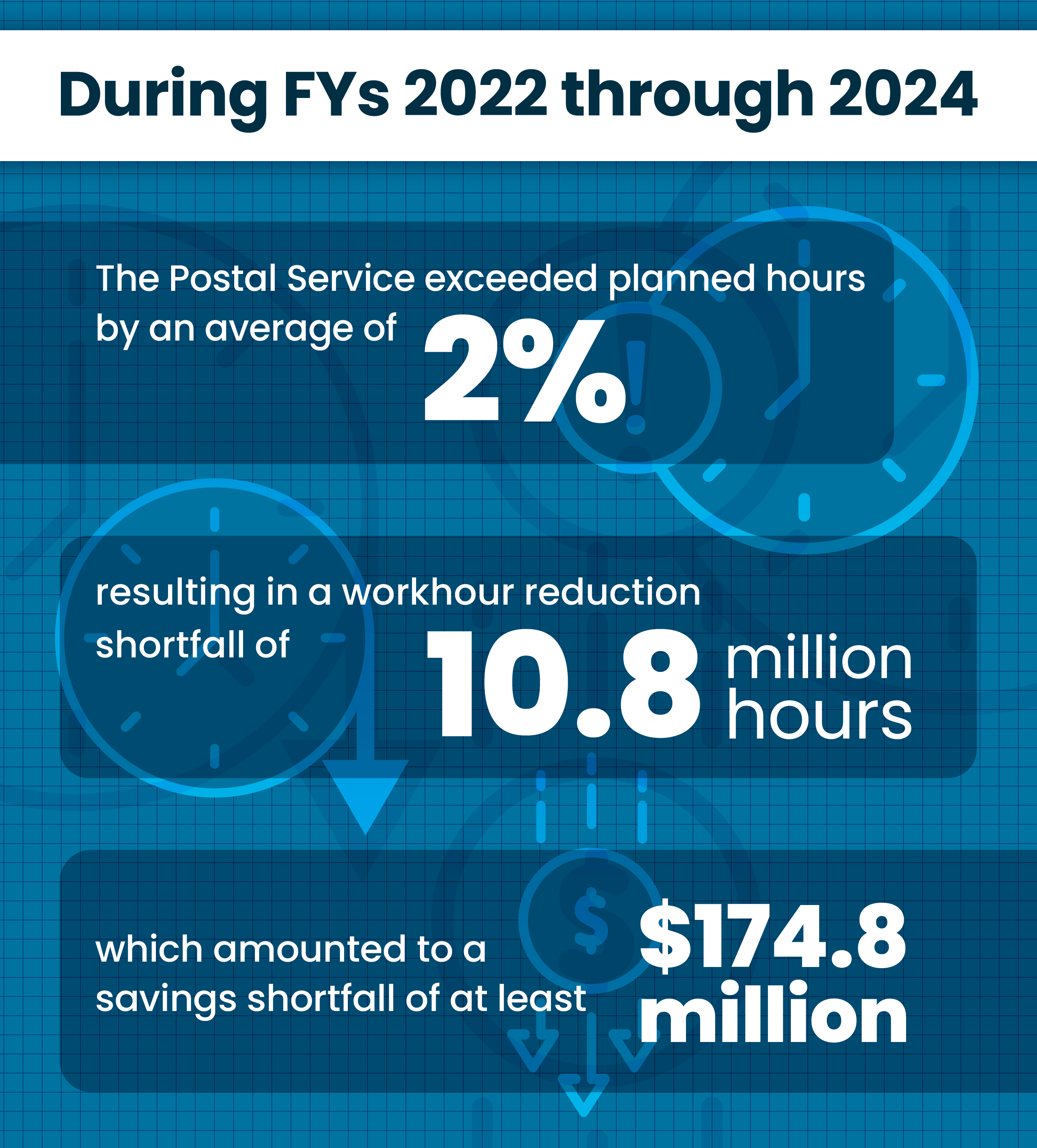
Efforts to Reduce Workhours in Mail Processing. Source: OIG.
Efforts to Reduce Workhours in Mail Processing. Source: OIG.
Our audits and white papers shed light on areas the Postal Service can improve its workforce management. One audit examined the effectiveness of USPS’s Workplace Violence Prevention Program between FYs 2022 and 2024, finding violence incidents are being underreported by Threat Assessment Teams and facility managers. And a white paper by our Office of Audit looked at increasing costs in workers’ compensation at the Postal Service, which rose significantly by $277.2 million (23 percent) between chargeback years (CBY) 2022 and 2024.
Compared to private industry, USPS’s workers’ compensation cost per workhour was consistently greater during those CBYs. If the Postal Service was allowed to adopt private industry practices to control these costs, it could have potentially saved $4.15 billion over a 10-year period, from CBYs 2015 to 2024.
Our research arm also published a white paper that compared organizations in the public and private sectors to identify best practices that can better inform USPS’s recruiting, hiring, and onboarding strategies. The paper comes as the agency has struggled to retain pre-career (temporary) employees and attract enough applicants to fill some open positions. What are possible solutions to this problem? The use of AI to optimize talent acquisition, quickly bringing new hires on board, and boosting retention with effective onboarding, among others.
We invite you to read this latest Semiannual Report to Congress to learn more about the topics above, the challenges Postal Service management is facing, as well as our investigations into senior executives and whistleblowers who have alleged reprisals.
For the latest updates on our work, be sure to subscribe to our emails or follow us on LinkedIn, Facebook, X (formerly Twitter), and Threads.

Click the image above to read the latest Semiannual Report to Congress.
Click the image above to read the latest Semiannual Report to Congress.
Additional Resources






Contact Us
For media inquiries, please email press@uspsoig.gov.